

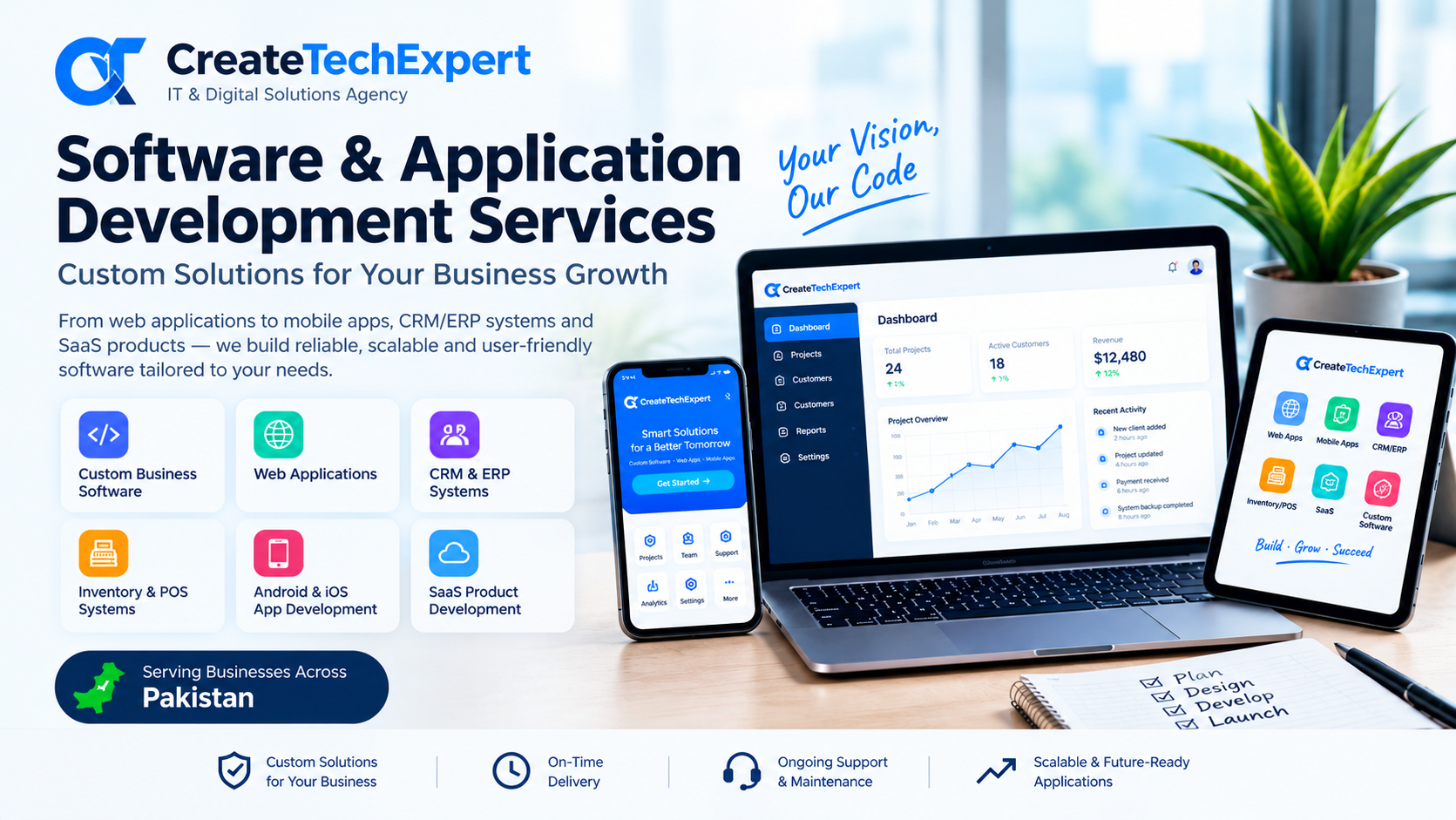
CreaTechExpert provides software and application development services to help businesses streamline operations, improve productivity, and build digital products around their specific requirements. From custom business software and web applications to CRM and ERP systems, inventory and POS solutions, mobile apps, and SaaS products, we help turn business ideas into practical software solutions.
Whether you are a startup planning a new digital product, a retailer looking to manage inventory, or an established business seeking to automate its workflows, we can help define your requirements and plan a suitable development solution.
Our approach focuses on understanding your business processes, designing useful functionality, and developing software that supports your operational goals.
Every business has its own processes, challenges, and operational requirements. Custom business software can help manage tasks that standard applications may not handle effectively.
Our custom software development services may include:
We begin by understanding your existing workflow and identifying the features your business needs. The proposed solution is then planned around the agreed requirements, budget, and project scope.
Web applications allow users to access software through a web browser, making them suitable for business portals, internal management tools, online platforms, and customer-facing services.
Our web application development services may include:
We consider usability, performance, access permissions, and future maintenance when planning a web application. Hosting, third-party integrations, and ongoing support are defined according to the project requirements.
A Customer Relationship Management (CRM) system helps businesses organize customer information, track enquiries, manage sales activities, and maintain visibility into customer relationships.
CreaTechExpert can help plan and develop CRM solutions based on your sales process and customer management needs.
CRM functionality may include:
A suitable CRM can help teams organize customer information and reduce reliance on scattered spreadsheets or manual records.
Enterprise Resource Planning (ERP) systems help businesses coordinate information and processes across different departments. A suitable ERP solution can provide a more organized view of business operations.
Depending on your business requirements, ERP development may include:
ERP projects require careful planning because departments may share data and depend on interconnected workflows. We define the required modules, user roles, reports, integrations, and implementation stages before development begins.
Accounting, tax, payroll, and other regulated functions must be scoped according to the applicable requirements and the capabilities of the selected solution.
Retailers, wholesalers, distributors, and other businesses often need reliable ways to track products, sales, purchases, and stock movement. Inventory management and Point of Sale (POS) software can help bring these activities into a more organized system.
Our inventory and POS solutions may include:
The final features depend on your business model, number of outlets, transaction volume, hardware requirements, and reporting needs. We assess these requirements before recommending a suitable approach.
Mobile applications can help businesses serve customers, support employees, and provide convenient access to digital services. We help plan mobile application projects around their intended users and functionality.
Mobile app projects may include:
We evaluate the required features, user experience, technical approach, backend services, and target devices before recommending an implementation plan.
Publishing an app to the Google Play Store or Apple App Store depends on the relevant developer accounts, platform policies, review processes, and project requirements. Store approval cannot be guaranteed.
Software as a Service (SaaS) allows customers to access software through an online service, often using a subscription or recurring payment model. SaaS can be suitable for startups and businesses planning to offer a digital product to multiple customers.
CreaTechExpert can assist with SaaS product planning and development, depending on the project scope.
SaaS development may include:
A SaaS product needs careful consideration of data separation, access control, reliability, scalability, billing, and ongoing support. We help define the initial product scope and prioritize essential features for a practical development roadmap.
Businesses often use multiple tools that need to exchange information. Software integration can reduce repetitive work and help maintain more consistent records across supported systems.
Services may include:
Integration feasibility depends on the third-party platform's API, access permissions, documentation, licensing, and technical limitations.
Well-planned data structures help applications store, retrieve, and manage information effectively. Database design is an important part of many custom software and web application projects.
Our database-related services may include:
Database design is based on the application's data volume, usage patterns, security requirements, and future maintenance needs.
Software may need ongoing updates as business requirements change, users identify issues, or operating environments evolve.
Maintenance and enhancement work may include:
Step 1: Requirement Analysis
We discuss your business objectives, users, current processes, desired features, and technical requirements.
Step 2: Scope & Project Planning
We define the proposed functionality, deliverables, technology considerations, project stages, dependencies, and estimated costs.
Step 3: UI/UX & Solution Design
Where required, we plan user flows, interface layouts, system architecture, and data structures before implementation.
Step 4: Development & Integration
The approved solution is developed in stages, including agreed functionality and supported integrations.
Step 5: Testing & Quality Checks
We test the agreed features and address identified issues within the project scope before handover.
Step 6: Deployment & Handover
We assist with deployment and provide relevant instructions or documentation according to the agreed deliverables.
Step 7: Maintenance & Improvements
Further support, bug fixes, upgrades, and new features can be discussed under an agreed maintenance arrangement.
Business-focused development: Solutions planned around your actual workflows and objectives.
Custom functionality: Features selected according to your project requirements.
Structured planning: Clear project scope, deliverables, and implementation stages.
Practical usability: Attention to the experience of customers, employees, and administrators.
Integration planning: Consideration of supported third-party tools and existing systems.
Long-term considerations: Planning for maintenance, documentation, and future improvements.
We focus on defining a realistic solution before development so the project aligns with your operational needs and available resources.


The appropriate solution depends on your business processes, budget, technical requirements, and expected number of users. Our services may be suitable for:
 Startups building their first software product
Retailers and wholesalers
Service-based companies
Businesses managing inventory or multiple branches
Entrepreneurs planning SaaS products
Small and medium-sized businesses
E-commerce businesses
Sales and customer support teams
Organizations seeking workflow automation
Businesses replacing manual spreadsheets with software

